Where roots meet partners.
Plants don’t live alone. Beneath every healthy crop is a community of bacteria and fungi that decide what gets in, what gets defended, and what gets fed. We study those conversations and learn how to shape them.

Spatial signatures of host immune restriction govern rhizobial strain selection in Lotus japonicus root nodules
Iyer A, Lehtonen H, Moreau L, Aurelia M
Not every compatible rhizobial strain ends up inside a root nodule. By mapping host immune outputs at single-cell resolution across the Lotus japonicus root cortex, we show that nodule occupancy is decided long before bacterial entry — in a narrow window of locally relaxed immunity that only some strains can read. The work reframes strain selection as a spatial negotiation, not a binary compatibility switch, and suggests new levers for designing inoculants that survive the host’s first hour of scrutiny.
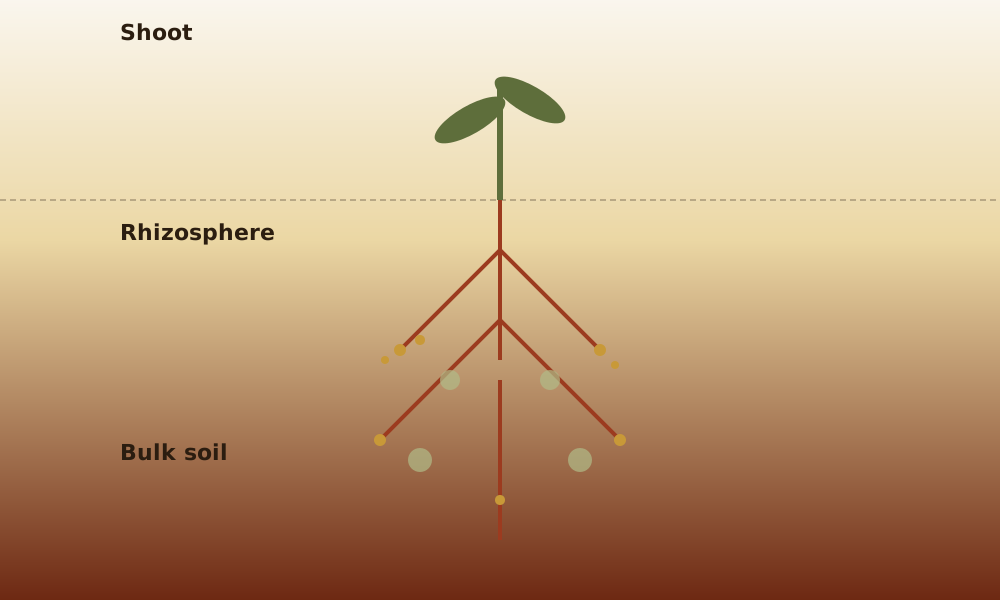
Research Overview
Our work centres on the rhizosphere — the millimetre of soil around a plant root — where bacteria, fungi, and host immune cells negotiate access in real time. We combine field surveys of agricultural soils with controlled gnotobiotic plant systems to ask how mutualistic communities assemble, persist, and collapse.
A second program focuses on legume–rhizobia nitrogen fixation. Using genetic tools in Medicago truncatula and Lotus japonicus, we map the signalling networks that allow a host to admit a microbial partner into its cells without triggering full immune rejection. The same logic may apply to engineered symbioses in non-legume crops.
Across both programs we are translating findings into microbiome-informed agronomic strategies — inoculants, cover-crop sequences, and host-genotype matching — that reduce synthetic nitrogen and phosphorus inputs without sacrificing yield. Our long-term aim is a soil-microbiome toolkit usable by smallholder and industrial growers alike.
What's new
Open positions
We are growing. Three openings are currently active — write to Marisol with a one-page note about what you want to grow.
-
Postdoctoral Researcher — Mycorrhizal community assembly
3 years · externally funded
Applications open until filled. -
PhD Candidate — Synthetic-biology platform for non-legume hosts
4 years · starts Sep 2026
Apply by 15 March 2026. -
Research Technician — Gnotobiotic plant facility
Permanent, 100% FTE
Rolling — review begins April 2026.